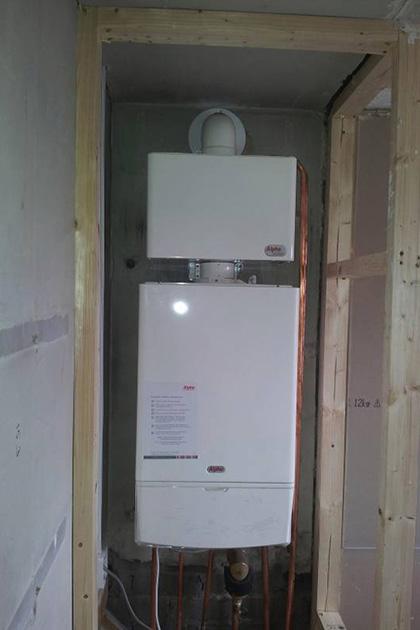
If you have a combi boiler, the setting that heats your radiators works best at 60°C or lower, yet many boilers are left at 70 to 80°C. Turning it down lets the boiler run in its most efficient mode, and in most homes the radiators still heat the rooms well, just a little more gently.
This post explains what flow temperature is, why a lower setting saves gas, how to change it from the controls on the front of the boiler, and when it's better to leave it higher. Everything here uses the normal controls. You never need to remove the boiler's casing, and if you have a hot water cylinder, the advice is different.
What flow temperature means
Flow temperature is the temperature your boiler heats water to before it's pumped round your radiators. It isn't the same as your room thermostat, which decides how warm the room should get. The flow temperature decides how hot the radiators run while they get it there.
Most combi boilers have two settings: one marked with a radiator symbol for the heating, and one with a tap symbol for your hot water. Flow temperature is the radiator one. Changing it doesn't affect how hot the water from your taps and shower is.
Why a lower setting saves gas
Modern combi boilers are condensing boilers. That means they capture extra heat from the hot gases leaving through the flue (the pipe that carries fumes out of the house) by cooling them until the water vapour in them turns back into liquid. That only works properly when the water coming back to the boiler from the radiators is cool enough, roughly below 55°C.
With the flow set at 75 or 80°C, the returning water is often too hot for the boiler to condense, so useful heat goes straight out of the flue. At 60°C or below, the boiler spends much more of its time in condensing mode.
Nesta, the UK innovation charity, tested this close to home at the University of Salford's Energy House, a traditional early 20th-century terraced house built inside a climate-controlled chamber. Its research found an average home could cut its gas use by about 10% by lowering the flow temperature from 75°C to 60°C, which it puts at around £57 a year at autumn 2026 prices.
How to change it safely
- Find the heating control on the front of the boiler, usually a dial or button with a radiator symbol. Leave the tap (hot water) setting alone.
- Turn it down to 60°C. If your dial shows numbers or bars rather than degrees, the boiler's user manual will say which setting matches.
- Leave it for a few days and see how the house feels.
- If the rooms stay comfortable, try 55°C, and keep going down in 5°C steps until the rooms take too long to warm up. Then go back up one step.
If you can't find the setting, the user manual will show you. You can usually find it online by searching your boiler's make and model, or its GC number, a seven-digit number starting with GC that's printed on the boiler. If a smart thermostat or app controls your boiler, the flow temperature may be set there instead.
Only ever use the controls on the outside. Never take the casing off to look for a setting. The parts behind it carry gas and mains electricity, and any work inside must be done by a Gas Safe registered engineer.
What to expect after you turn it down
Your radiators will feel warm rather than hot to the touch. That's normal. Rooms may take a little longer to warm up, so you might set the heating to come on a bit earlier. Many people don't notice any difference at all.
Your water pressure and hot water won't change. In the coldest weeks, if the house struggles to get warm, turn the flow temperature up by 5°C and give it a few days. Many people lower it further in spring and early autumn and raise it again in winter.
When to keep it higher
A lower flow temperature isn't right for every home or household. Keep it a little higher if:
- someone at home is especially sensitive to the cold, for example with a heart condition, asthma, arthritis, osteoporosis or fibromyalgia, so rooms warm up faster (and make sure someone in the house knows how to turn it back up)
- your home is draughty or poorly insulated and still feels cold after a few days at 60°C
- a room never gets warm enough because its radiator is too small for the space
If a few radiators stay cool while others are fine, they may need balancing so hot water reaches every one evenly. Our guide on how to balance radiators walks you through it. If a room is simply short of radiator, a larger one can let the whole house run at a lower, cheaper temperature. That's part of the work we do on central heating installations.
If you have a hot water cylinder
This advice is for combi boilers, which heat water as you use it. If you have a system or regular boiler with a hot water cylinder (a tank, usually in an airing cupboard), don't turn down the temperature of your stored hot water. Stored hot water needs heating to 60°C or above to stop Legionella bacteria growing, which can cause Legionnaires' disease, a serious lung infection. Nesta's guidance doesn't cover these systems, so ask a heating engineer before changing their settings.
Not sure which type you have? Our post on combi and system boilers explains the difference.
Ask about it at your next service
If you'd rather not change it yourself, or you'd like it set up for your home, ask at your next boiler service. A Gas Safe registered engineer can check the settings, confirm the boiler is burning cleanly and show you which control to use. As a Baxi Approved Installer, we're trained to fit and service Baxi boilers, and the same principle applies to every modern combi.
AB Plumbing and Maintenance services and repairs combi boilers across Tottington, Bury and the surrounding area. If you'd like your heating settings looked at, book a boiler service with us and ask us to check them while we're there.